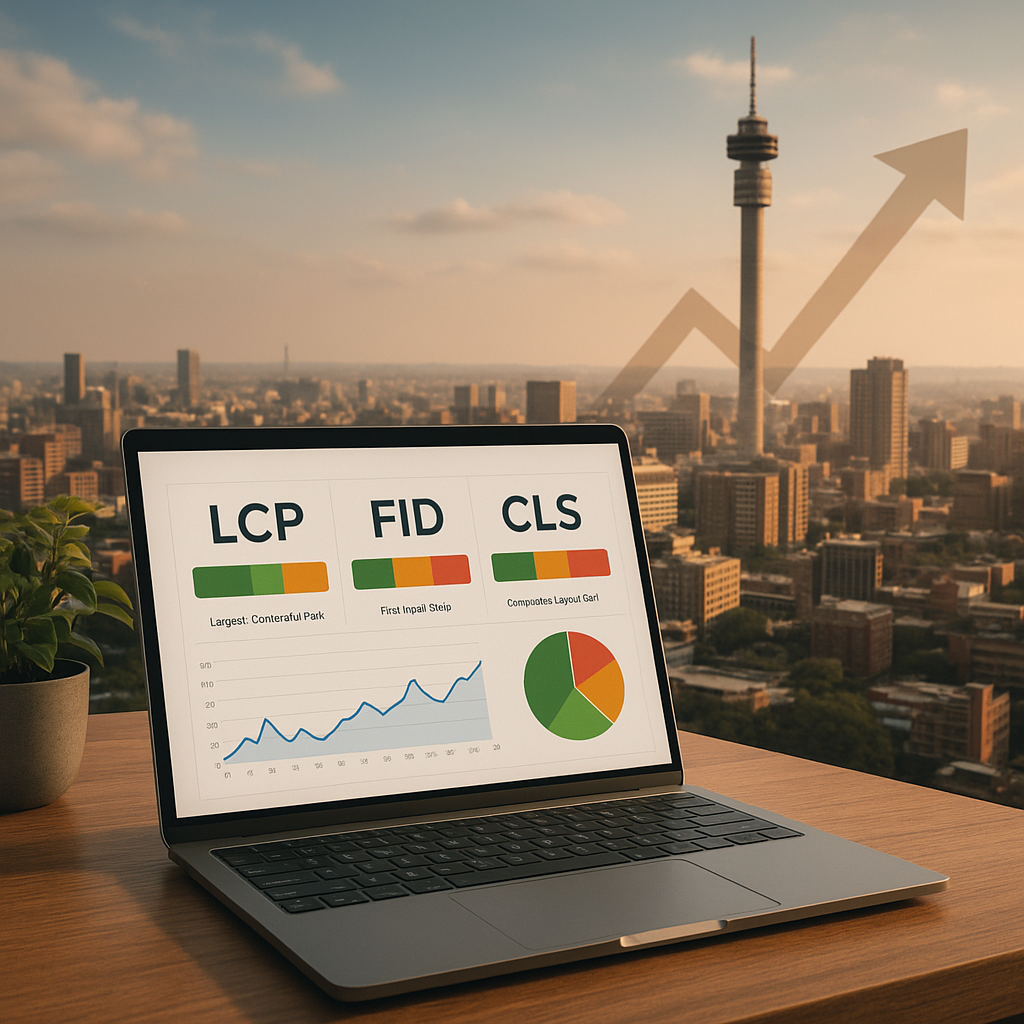
The influence of Core Web Vitals on SEO outcomes is growing rapidly, especially for competitive markets like Johannesburg. Optimizing these metrics can transform a local business website’s visibility, user engagement, and conversion rates. In this article, we’ll explore how Johannesburg-based companies can leverage loading speed, layout stability, and interactivity to climb the search rankings and dominate the local digital landscape.
Understanding Core Web Vitals
Core Web Vitals are a set of standardized metrics defined by Google to measure real-world user experience on web pages. They consist of three primary dimensions:
- Largest Contentful Paint (LCP): Measures loading performance. A fast LCP (ideally under 2.5 seconds) ensures the main content appears quickly.
- First Input Delay (FID): Assesses interactivity. A low FID (below 100 ms) indicates that pages respond promptly when users click or tap elements.
- Cumulative Layout Shift (CLS): Evaluates visual stability. A CLS score under 0.1 signifies minimal unexpected layout shifts as content loads.
These indicators combine to convey how users perceive page speed, responsiveness, and smoothness. For local businesses in Johannesburg, investing in these metrics means offering a frictionless journey for visitors browsing on diverse devices and network conditions.
Local SEO Dynamics in Johannesburg
Johannesburg’s digital marketplace is characterized by fierce competition across industries such as hospitality, real estate, and retail. Key factors shaping local SEO success include:
- Accurate Google Business Profile optimization
- Localized content strategies that incorporate neighborhood names and regional slang
- Mobile-first indexing due to widespread smartphone adoption
- High-speed connectivity expectations among urban users
In this scenario, page speed and user experience become crucial differentiators. If two coffee shops in Sandton have similar on-page SEO, the one with superior Core Web Vitals will likely outrank the other, attracting more organic clicks.
Impact of Core Web Vitals on Johannesburg SEO Rankings
LCP and First Impressions
Imagine a property listing website in Rosebank. If the page’s hero image or map container lags beyond 3 seconds, potential clients may abandon the site, signaling to Google that the page offers poor experience. A faster LCP not only reduces bounce rates but also signals to search engines that the content is valuable and accessible.
FID as a Conversion Driver
Businesses offering online bookings—whether for salons, restaurants, or guided tours—need rapid response when users tap “Reserve Now.” A swift FID translates directly into higher booking completions. Google’s bot interprets low input delay as part of its ranking algorithm, favoring sites where interactions feel instantaneous.
CLS and Brand Credibility
Unexpected layout shifts frustrate users and can even cause erroneous clicks on adverts or calls to action. In Johannesburg’s competitive e-commerce scene, a product page that shifts while a user is about to add an item to the cart may lead to abandonment. Reducing CLS enhances trust and prevents revenue loss.
Practical Optimization Strategies
Improving Core Web Vitals involves both technical adjustments and content optimization:
1. Image and Media Optimization
- Use responsive image formats (WebP) and implement lazy loading to defer offscreen images.
- Specify explicit width and height attributes to prevent layout jumps.
2. Efficient Resource Loading
- Minify CSS, JavaScript, and HTML to reduce payload size.
- Split large JavaScript bundles and prioritize critical code using code-splitting.
- Use preconnect or dns-prefetch for third-party domains to shave valuable milliseconds off fetch times.
3. Server and Hosting Enhancements
- Choose a local CDN edge node in South Africa to lower latency for Johannesburg visitors.
- Employ HTTP/2 or HTTP/3 protocols for concurrent resource fetching.
- Leverage server-side caching and implement lazy loading for dynamic elements.
4. JavaScript and Third-Party Script Management
- Defer non-critical scripts to improve initial loading.
- Audit and eliminate unused code libraries.
- Use asynchronous loading for analytics and ad scripts.
Monitoring and Continuous Improvement
Consistency in monitoring is essential. Johannesburg businesses can adopt a combination of field and lab tools:
- Google Search Console’s Core Web Vitals report for real-user metrics.
- PageSpeed Insights for lab-based suggestions.
- WebPageTest for advanced waterfall analysis and video capture of load behavior.
- Lighthouse CI in Continuous Integration pipelines to catch regressions before deploying new features.
By setting performance budgets for LCP, FID, and CLS, teams can receive alerts whenever thresholds are breached. This proactive approach prevents ranking declines and maintains a competitive edge in the Johannesburg market.
Case Study: A Johannesburg Retailer’s Success Story
A boutique fashion retailer in Maboneng overhauled its site by compressing images, migrating to an edge-hosted Headless CMS, and deferring non-essential scripts. Within two months:
- LCP improved from 4.2s to 1.9s
- FID dropped from 220ms to 50ms
- CLS stabilized from 0.35 to 0.05
- Organic traffic increased by 35%
- Conversion rate rose by 18%
This example highlights the direct correlation between performance optimization and local SEO gains in Johannesburg’s bustling online ecosystem.